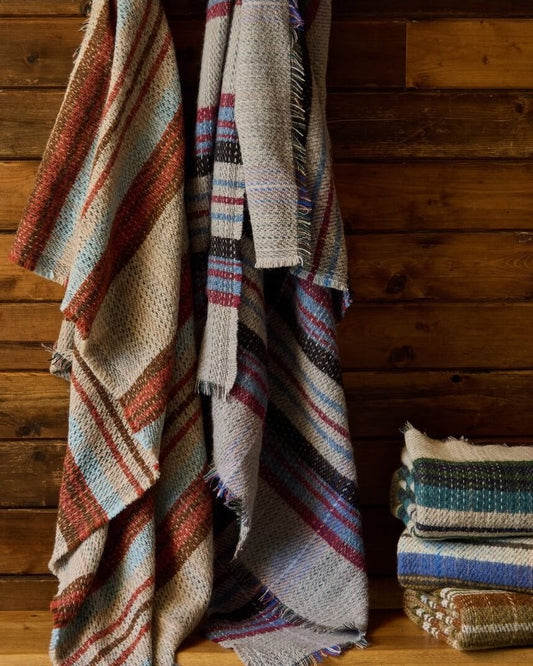
At Weald Store, our collection of Tweedmill blankets and throws includes pure new wool designs alongside recycled wool blankets made using surplus yarn. Both offer a practical way to add warmth and texture to a room, whether draped over a sofa or layered across a bed.
Wool is valued for its natural warmth, breathability and durability, while the choice of yarn and weave gives each blanket its own character. From traditional tartans and checks to simpler herringbone and geometric patterns, there are plenty of options to suit different interiors.
What is Wool?

Wool is a natural animal fibre, most commonly obtained from sheep. Its structure gives it several useful properties. The fibres are naturally crimped, helping to trap air and provide insulation, while their ability to absorb moisture vapour contributes to wool's breathability.
Not all wool is the same. The thickness, length and softness of the fibres vary according to the sheep breed and other factors. These differences influence the feel, appearance and performance of the finished fabric.
The type of wool and the way it is spun and woven influence the feel and appearance of the finished fabric. Some blankets have a softer, smoother handle, while others have a more substantial texture. The weave also affects how a blanket drapes and how clearly its pattern appears.
Why Choose a Wool Blanket?

Wool has several natural properties that make it well suited to blankets and throws.
Its crimped fibres trap air, helping to retain warmth, while its ability to absorb moisture vapour contributes to breathability. Wool is also naturally odour-resistant, so airing a blanket is often enough to freshen it between uses.
These qualities make wool blankets practical as well as decorative, providing an extra layer of warmth while adding colour and texture to a room.
How Are Wool Blankets Made?

Turning wool into a finished blanket involves several stages, from preparing the fibre to weaving and finishing the fabric. The precise process varies between mills and products, but the main stages are broadly similar.
After shearing, the fleece is sorted and cleaned to remove dirt, grease and other material. The wool is prepared for spinning and may be dyed at different stages of the process, depending on the desired colour and finish.
Carding separates and aligns the fibres, preparing them to form yarn. The fibres are then spun into continuous strands. The thickness and character of the yarn influence the texture and appearance of the finished blanket.
The yarn is woven on a loom, with threads running lengthways and crossways to form the fabric. Different arrangements of the threads create different weaves and patterns. Herringbone, for example, has a distinctive broken zigzag pattern. Checks and tartans are created through the arrangement of coloured yarns, while geometric designs use repeated shapes to create their characteristic appearance.
Once woven, the fabric may be washed, brushed or otherwise finished to achieve the desired texture and feel. The edges are finished and any fringes or decorative details are added before the blanket is checked and prepared for sale. Each stage contributes to the character of the finished textile, from the feel of the fabric to the way it hangs over a sofa or bed.
Pure New Wool and Recycled Wool

Our Tweedmill collection includes both pure new wool blankets and recycled wool designs.
Pure new wool is wool used for the first time in a textile product, rather than wool recovered from previously manufactured textiles. Our pure new wool blankets include traditional tartans and checks alongside herringbone and geometric designs, in colours ranging from natural and understated to more distinctive patterns.
Tweedmill's recycled wool blankets make use of surplus yarn to create new colour combinations and patterns. The resulting designs offer a different mix of colours and textures, with each blanket having its own character.
Where Are Tweedmill Blankets Made?

Tweedmill Textiles is a family-run business established in 1971. Based near the Clwydian mountain range in Wales, it has been producing textiles for more than 50 years, using traditional weaving techniques alongside contemporary designs.
The collection includes traditional tartans and checks alongside herringbone and geometric patterns. Alongside pure new wool blankets, Tweedmill also produces recycled wool designs using surplus yarn.
It is worth distinguishing between where a blanket is made and where its raw materials originate. Although Tweedmill blankets are woven in Wales, the wool is sourced in New Zealand. The sheep are bred for their soft fleece, with high animal welfare standards that allow them to roam freely. The wool is also mulesing-free.
Wool Blanket Care
Wool is naturally odour-resistant, and airing outside is often enough to freshen up a blanket between uses.
If washing is necessary, follow the care label. Where permitted, hand wash in cold water or use a cold wool cycle with a mild wool detergent. Wash separately and avoid wringing or spinning.
Reshape while damp and dry flat or line dry, following the manufacturer's instructions. Do not tumble dry unless the care label specifically allows it.
Are Wool Blankets a Sustainable Choice?

Wool is a renewable natural fibre because sheep grow a new fleece. It can also biodegrade under suitable conditions.
The environmental impact of a blanket depends on more than the fibre alone. Farming, processing, transport, product lifespan and what happens to the textile at the end of its use all play a part.
A well-made blanket that is used and cared for over many years may not need replacing as frequently as a shorter-lived alternative. Recycled wool offers another approach by making use of existing textile materials.
Explore our collection of Tweedmill blankets and throws, from pure new wool tartans and herringbone designs to recycled wool blankets in colourful patterns. Shop Tweedmill Blankets & Throws.